
History
The early years
During the period 1960 to 1964, Trinidad and Tobago was plagued by a number of strikes by workers and lockouts by employers which affected the economy. The Hansard records show that during that period, there were 230 strikes involving 74,574 workers resulting in 803,899 man days lost.
In response to the growing unrest in the industrial relations climate, the Government introduced the Industrial Stabilisation Bill in the House of Representatives on March 18, 1965. The Bill was passed in Parliament on March 19, 1965 and was assented to by Governor General Sir Solomon Hochoy the next day. Thus on March 20, 1965, the Industrial Court of Trinidad and Tobago was established by Section 5(1) of the Industrial Stabilisation Act (ISA) and became the first Industrial Court in the English-speaking Caribbean.
The purpose of the Act, as stated in its preamble, was “to provide for the compulsory recognition by employers of trade unions and organisations representative of a majority of workers, for the establishment of an expeditious system for the settlement of trade disputes, for the regulation of prices of commodities, for the constitution of a court to regulate matters relating to the foregoing and incidental thereto.”
At its inception in 1965, the complement of Judges was five (5), consisting of the President, the Honourable Mr. Justice Sir Isaac Hyatali, Dr. Zin A. Henry, Mr. Harold A. Hutson, Mr. Gregory C. Awang and Dr. James Lewis. In 1967, the Act was amended to allow for an increase in the membership of Judges of the Court from five (5) to seven (7) and enabled the Court to sit in more than one Division.
Becoming a superior court of record
In the matter of Trinidad Bakeries Ltd. & National Union Foods, Hotels, Beverages and Allied Workers & The Attorney General on behalf of the People of Trinidad and Tobago, [Civil Appeal 53/1966 (TD 2 of 1966)], the Court of Appeal ruled that the “Industrial Court has no jurisdiction to make a non-consensual order or award for the reinstatement of dismissed workers.” As a result, a second amendment to the Act (Act No. 11 of 1967) on June 14, 1967 conferred power on the Court to reinstate workers. This amendment also made the Industrial Court a superior Court of record, with all the powers inherent in such a court.
The constitutionality of the Act was challenged in the famous case of Collymore v. Attorney-General (1967), and as a consequence of that challenge, the Act was repealed and replaced by the Industrial Relations Act, 1972 (IRA), which made “better provision for the stabilisation, improvement and promotion of industrial relations.”
The new IRA facilitated the creation of the Office of Economic and Industrial Research, the main purpose of which is to provide research to support the Industrial Court and the social partners of industry. The Registration, Recognition and Certification Board is also a creation of the IRA; its main function is to peruse applications made by trade unions for bargaining status and to issue Certificates of Recognition where necessary.
A growing jurisdiction
The first amendment of the IRA was in 1978 (Act 44 of 1978), which provided for the two Divisions of the Court, namely the General Services Division and the Essential Services Division. In 1979, the IRA was further amended (Act 2 of 1979) to provide for the President of the Republic of Trinidad and Tobago to indicate to which Division of the Court Judges were appointed. The last amendment of the IRA was in 1987 (Act 3 of 1987), which enabled the Minister of Labour to refer an unresolved dispute to the Industrial Court after a period of three (3) months or more of continuing industrial action.
Over the years, additional legislation was placed under the jurisdiction of the Industrial Court to strengthen the Court’s ability to adequately dispense social justice. This legislation includes the Minimum Wages Act Chapter 88:04, the Retrenchment and Severance Benefits Act Chapter 88:13, the Maternity Protection Act Chapter 45:57 and the Occupational Safety and Health Act Chapter 88:08.
The home of the Court
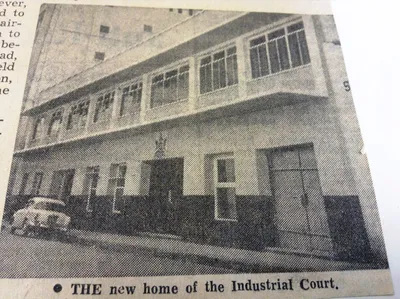
On April 29, 1965, the new Industrial Court held its first sitting at the Sixth Supreme Court, situated at the Red House in Port of Spain, hearing the trade dispute between the Federated Workers Trade Union and the University of the West Indies, St. Augustine & the Attorney General on behalf of the people of Trinidad and Tobago. By October 1965, the Chronicle Building on St. Vincent Street, Port of Spain was renovated to house the Court.
In 1995, then Prime Minister, the Honourable Patrick Manning, turned the sod at the site for the new Industrial Court building. Two years later, on May 27, 1997, then Prime Minister, the Honourable Basdeo Panday, handed over the building at its current location to then President of the Industrial Court, His Honour Mr. Leopold P.E. Ramchand.
On February 15, 2005, under the leadership of then President, His Honour Mr. Addison M. Khan, the Court expanded its operations to southern Trinidad when it opened a branch in San Fernando. In 2015, under the leadership of the immediate past President, Her Honour Mrs. Deborah Thomas-Felix, the Court achieved another significant milestone when it acquired the Sandy Hall Building in Scarborough, Tobago, to be renovated to house the Tobago branch of the Industrial Court.
The Court’s Logo
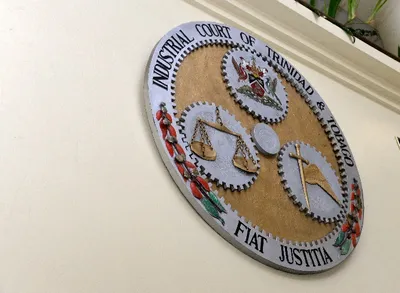
In 1965, the Honourable Justice Sir Isaac Hyatali, the inauguralPresident of the Industrial Court of Trinidad and Tobago,commissioned Kenwyn “Ken” Morris to create the Court’sofficial emblem (now referred to as the court logo), which was tobe recognised judicially in all Courts. Ken Morris, known as theCopper Man, was a master metal craftsman, renowned for hiswork in Carnival costume construction. In 1969, he was awardedthe Hummingbird Medal Bronze for his contribution to the FineArts of Trinidad and Tobago. This masterfully designed logo bypioneer Ken Morris hangs at the entrance of the Industrial CourtBuilding in Port of Spain to this day.
Presidents of the Court
Since the establishment of the Industrial Court in 1965, seven (7) individuals have been bestowed the honour to serve as President of the Industrial Court of Trinidad and Tobago.
- Her Honour Mrs. Heather Seale2023 - present
- Her Honour Mrs. Deborah Thomas-FelixDec 13, 2011 - Dec 12, 2023
- His Honour Mr. Cecil O. BernardDec 13, 2005 - Dec 12, 2011
- His Honour Mr. Addison KhanDec 13, 1999 - Dec 12, 2005
- His Honour Mr. Leopold P.E. RamchandNov 1, 1989 - Oct 19, 1999
- His Honour Mr. John A.M. BraithwaiteNov 1, 1972 - Oct 30, 1989
- The Honourable Mr. Justice Sir Isaac HyataliMar 20, 1965 - Oct 30, 1972